|
New numbers this week tell a story Canada hasn't seen in living memory. The country's population fell again — the third straight quarterly decline — and on a yearly basis it has now contracted for two reports running. You have to go back to at least 1947 to find the last time it dropped over a full twelve months.
For most of the country that's a worrying headline. For Calgary it's closer to a competitive advantage. Because while almost every province is now losing people, Alberta is still gaining them — for reasons that point directly at housing.
01 // The Shift
The country just went into reverse.
Between January and April, Canada lost just over 55,000 residents, bringing the national tally to roughly 41.4 million. The cause isn't a mystery. Two years ago the population was climbing more than three percent a year — about 1.2 million people added in 2024 alone, almost all from immigration.
Federal policy has since changed course sharply. Targets for non-permanent residents have been pulled toward five percent of the population by the end of 2027, and permanent immigration scaled back. The effect is immediate: non-permanent residents fell by nearly 118,000 in the first quarter, and permanent immigration slowed about twenty percent year over year. Underneath it all, natural increase — births minus deaths — has tipped slightly negative for two quarters running.
| “For the first time in generations, the country isn't growing on its own. That makes where the remaining growth lands more important than ever.” |
02 // The Outlier
Alberta is going the other way.
Alberta added 8,926 people in the first quarter, up about 0.2 percent in three months — one of only three provinces to grow at all, alongside Nova Scotia and Saskatchewan. Every other province shrank.
Over twelve months, Alberta's population grew 0.9 percent — its slowest pace since the pandemic, so this is no boom. But it's still the fastest of any province, at a moment when the national figure is negative. Slowing and still leading is a very different position than slowing and falling.
|
Population growth, year over year
Source: ATB Economics, Statistics Canada
|
| Canada, 2024 (peak) |
|
+3.0% |
| Canada, now |
|
−0.5% |
| Alberta, now |
|
+0.9% |
|
| Two years ago the country added people at better than three percent a year. Today it's contracting. Alberta, slower than its own peak, is still on the right side of the line. |
03 // Why People Are Coming
Two engines are still running.
Alberta's growth isn't an accident, and it isn't really about immigration anymore. Two homegrown forces do the work. The first is people moving here from other provinces: interprovincial migration has been net positive for nineteen consecutive quarters, gaining 6,006 people in the first quarter alone. The second is natural increase — unlike the country as a whole, Alberta still had more births than deaths last quarter, adding 3,568 people that way.
| Alberta's positive engines, Q1 2026 |
| Interprovincial migration (net) |
+6,006 |
| Natural increase (births less deaths) |
+3,568 |
Both engines pushed up. The drag was non-permanent residents, down 9,993 in the quarter — yet Alberta's net result stayed firmly positive at plus 8,926.
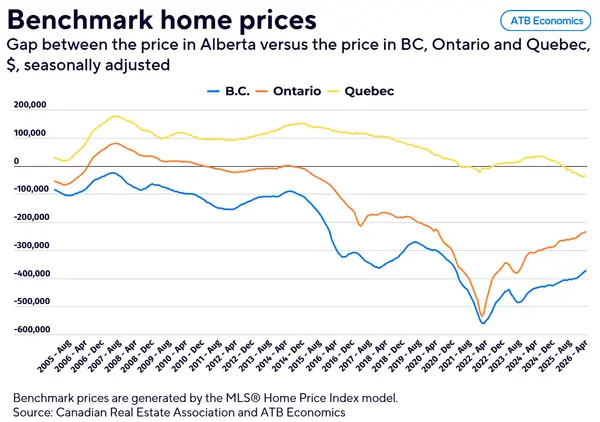
Why the inflow? Affordability is part of it: a Calgary home still costs a fraction of one in Toronto or Vancouver, and that gap has pulled families west for years. But increasingly the bigger draw is work. Alberta is leading every province in employment growth this year, and unemployment has dropped from a four-year high of 8.2 percent last August to 6.6 percent now. People follow jobs — and the jobs are here.
| “People don't move across the country for a view. They move for a paycheque and a home they can actually afford. Right now Alberta offers both.” |
04 // The Housing Read
Population growth is the quiet engine under every housing market — the demand side of the equation, moving slowly and steadily rather than in headlines. When a market keeps adding households while construction stays measured, demand for existing homes holds up.
That's roughly the picture here. Alberta's growth is cooling from its frenzy, taking some pressure off, and homebuilding is easing alongside it. But the province is still the only one pulling people in from everywhere else, and those people need somewhere to live. For a Calgary owner, that's a more reassuring backdrop than the national headline suggests. Be clear-eyed, though: slower growth is still slower. This is a steadier, more normal market — one where preparation and pricing matter more than a rising tide.
| The scoreboard, at a glance |
| Canada, quarterly change |
−55,025 |
| Canada, twelve-month change |
−0.5% |
| Alberta, quarterly change |
+8,926 |
| Alberta, twelve-month change |
+0.9% |
05 // The Forecast
Where this is heading.
For 2026, ATB Economics expects Alberta's population to grow 1.1 percent and the broader economy about 2.6 percent, helped by a steadier population base and an uptick in oil-patch activity. Both sit comfortably above the national pace, where the economy is forecast to crawl ahead by under one percent against a falling population.
None of that guarantees a hot housing market. It does describe a province whose foundations are still pointing the right way while much of the country resets. For anyone deciding whether to buy, sell, or simply hold in Calgary, that distinction is the whole point.
|